
The Bridge That Wasn't Supposed to Exist — And Why We're Glad It Does
Some landmarks earn their place in history through sheer inevitability. The Cotter Bridge earned its place through stubbornness, civic pride, and one county judge who may or may not have stolen a government report.
If you've ever driven into Cotter on U.S. Highway 62 Business and felt that pull — the urge to stop, get out of your car, and just look — you're not alone. The R.M. Ruthven Bridge, known to just about everyone as the Cotter Bridge, has been stopping people in their tracks since 1930. And once you know the story behind it, the structure feels even more remarkable.
Live View of Cotter Bridge!
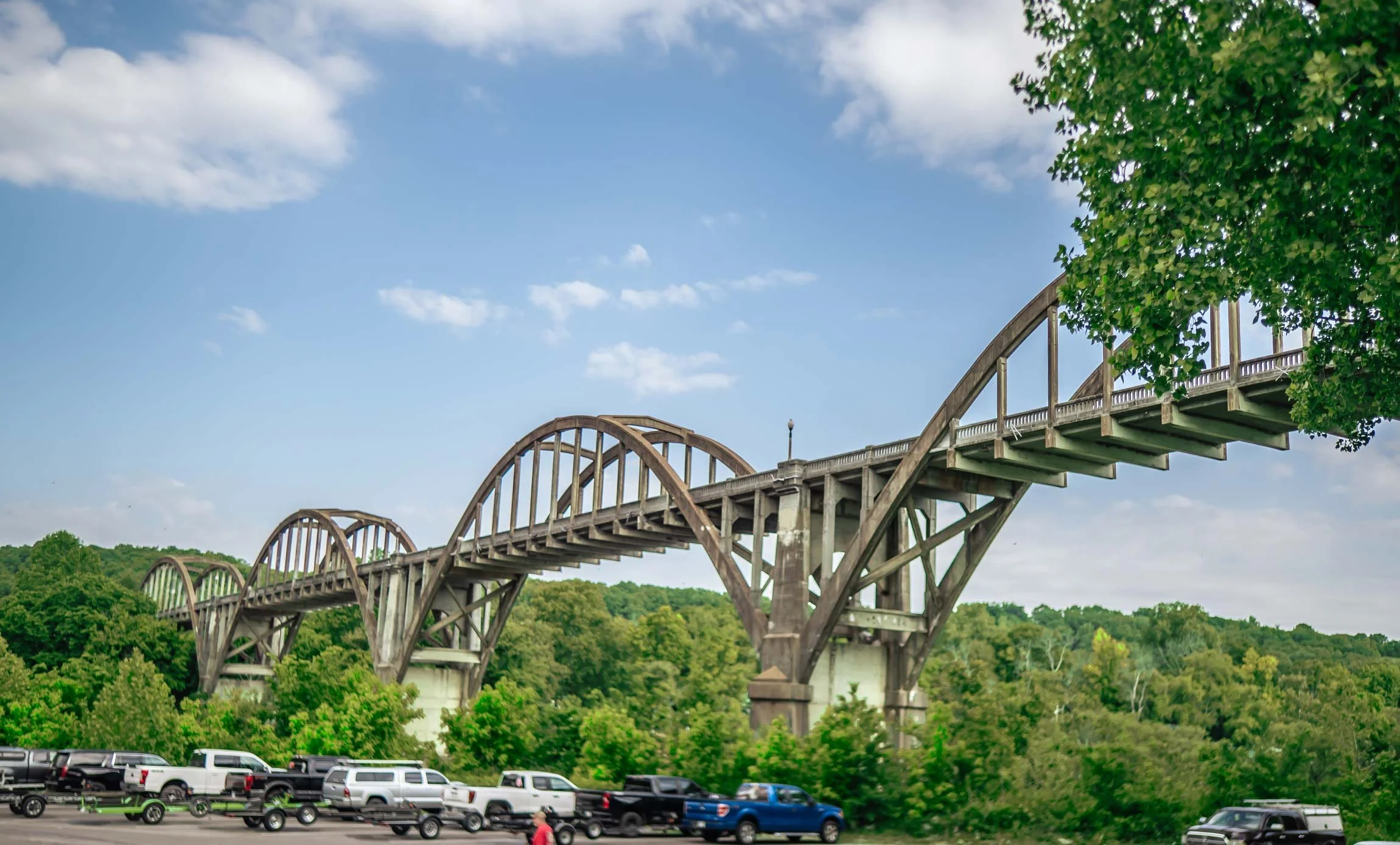
The Problem With the River
Before the bridge, the White River was a genuine barrier. Cotter was established in 1905 as a railroad town, and the area relied on a ferry system to cross the river — with the nearest road crossing located 100 miles north in Branson, Missouri. That's not a detour. That's a different trip entirely.
The river's unpredictability made things worse. The White River had a tendency to flood rapidly, grounding ferries and halting traffic for days at a time. Farmers couldn't get goods to market. Travelers were stranded. On busy days, the ferry crossing sometimes had as many as 100 cars waiting to pass. The people of Baxter County had wanted a bridge for years, and they weren't shy about saying so. A newspaper editorial of the era put it plainly: "Marion and Baxter counties need this bridge. And not these counties only, but all North Arkansas demands it. For a distance of more than 200 miles on White River above Batesville, there is no bridge."
Legislation authorizing construction was passed as early as 1912, but funding never materialized. It wasn't until 1927 — when Arkansas approved the use of toll bridges statewide — that the door finally cracked open.
The Judge, the Report, and a Twenty-Year Secret
Here's where the story gets good.
In 1927, the Arkansas Department of Transportation obtained approval to place nine toll bridges throughout the state. Baxter County Judge R.M. Ruthven pushed to add Cotter to the list of proposed sites, but a feasibility study — including a traffic count — was required before any site could be approved.
The study was conducted in June 1928. The findings, reportedly, did not support building a bridge at Cotter.
Judge Ruthven had other ideas.
Ruthven saw the survey report before the commission met, and he realized what it meant to the people of his county. When he returned home that afternoon, the Cotter report went with him, where it remained for two decades. The judge mailed it back to the commission twenty years later.
With no report on the table, the Highway Commission approved the Cotter site along with the others. President Calvin Coolidge signed the bridge into construction on May 2, 1928. Whether you call it bold civic advocacy or something more colorful, Ruthven's gambit worked — and the bridge that carries his name today stands as proof.
An Engineering Landmark
The Cotter Bridge utilizes a reinforced-concrete rainbow arch design patented by James Marsh in 1912 and designed by the Marsh Engineering Company. Frank Marsh himself came to Cotter in May 1929 to survey the construction site. The Bateman Contracting Company of Nashville, Tennessee, built the six-span structure at a cost of $500,000, and it stretches approximately 1,850 feet across the river.
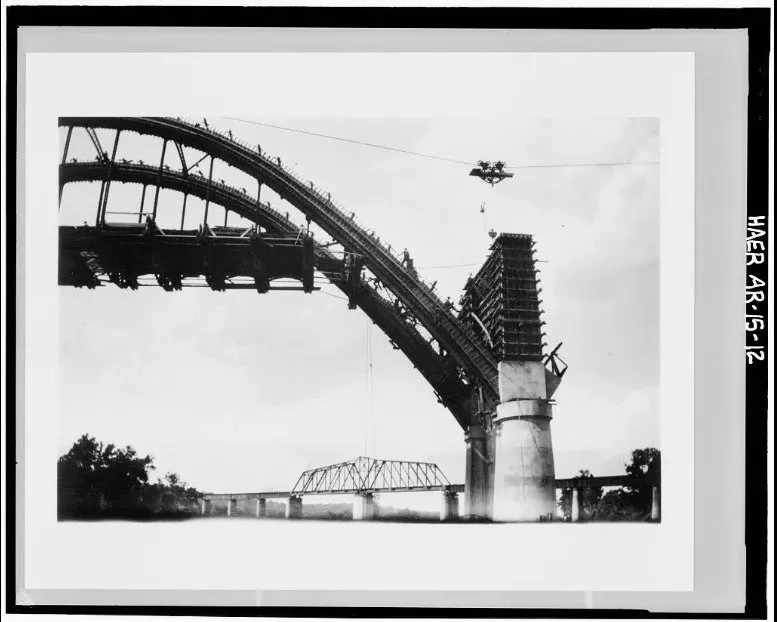
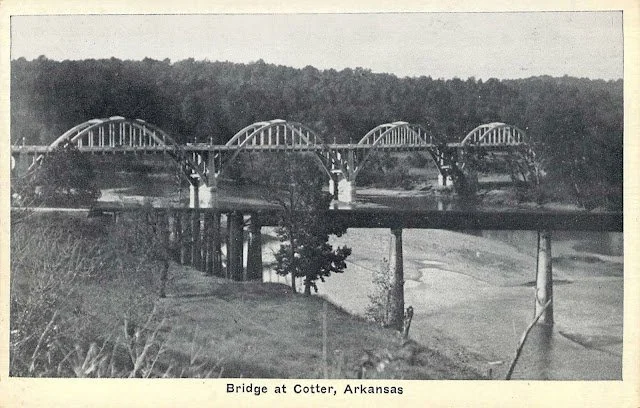
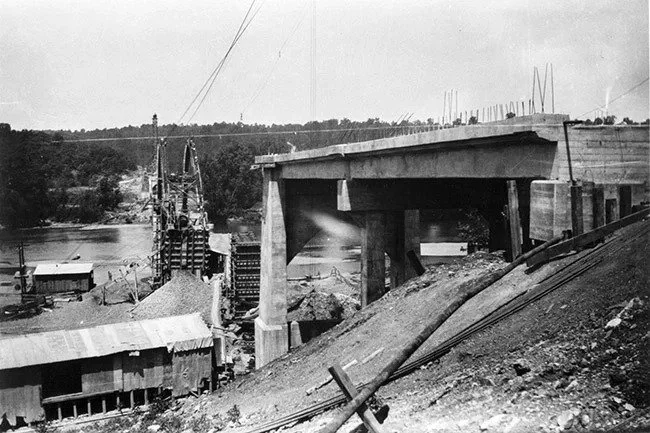
The bridge was finished six months ahead of schedule, using local labor for construction. That last detail matters. This wasn't just a state project dropped on a small town — it was built, in large part, by the hands of the people who lived there.
Upon its completion, the bridge was dedicated on November 11 and 12, 1930, in a ceremony attended by over 6,000 visitors from seven of the nine states traversed by Highway 62. For a town of a few hundred people on a horseshoe bend in the Ozarks, that was a moment.
The accolades followed over the decades. It was the first landmark in Arkansas to become a National Historic Civil Engineering Landmark, and it remains one of only a small number of bridges in the country designated as such. It is also listed on the National Register of Historic Places and the Historic American Engineering Record. Today, it holds the distinction of being the longest concrete rainbow arch bridge in the United States.
A Bridge Reborn
By the turn of the 21st century, nearly a century of weather, floods, and traffic had taken their toll. Restoration began in 2002, with forty-four workers involved in the effort. Despite delays, they completed the restoration on August 4, 2003, with the full project wrapping up in 2004.
The re-dedication in September 2004 was a celebration worthy of the occasion — vintage aircraft, vintage automobiles, and a poem written in honor of the workers who built and restored her. The lighting of the bridge — more than 3,000 lights in all — was celebrated on December 13, 2004. Today, the illuminated bridge reflected in the White River on a clear evening is one of the more quietly stunning sights in northern Arkansas.
What It Means to This Stretch of River
Standing on the bank of the White River below the Cotter Bridge, you feel the weight of all that history without it being heavy. The arches rise out of the water like something that was always supposed to be there — elegant, purposeful, unmistakably of a particular American era.
For those of us who spend our days on this river, the bridge is a constant. It's a landmark for guides orienting first-time anglers. It's a backdrop for sunrise photos no filter can improve. It's the thing your out-of-town guests see first and immediately want to know about.
The bridge is said to be the most-photographed bridge in Arkansas — a distinction that surprises no one who has seen it. Its sweeping arches against an Ozark sky, the White River curling beneath it, the hills going green in spring and gold in fall — it's the kind of image that makes people understand why folks who grew up here tend to come back. Rootsweb
The Cotter Bridge isn't just infrastructure. It's the story of a community that refused to be cut off from the rest of the world, a judge who played one of the more audacious cards in Arkansas political history, and a stretch of river that has been drawing people in — to fish, to float, to simply be — for longer than anyone can fully account for.
Come see it for yourself. The river's been waiting.
The Cotter Bridge is located on U.S. Highway 62 Business in Cotter, Arkansas, and is open to pedestrians. Big Spring Park along the White River offers excellent viewing and access to the riverbank below. Visit cotterbridge.org for more on the bridge's history and the Peitz River Lights.